Key takeaways: succeeding in wine and foie gras alliance requires favoring balance between smoothness and freshness. While sweet wines dominate on cold, grilled notes from hot cooking call for great dry white structure. This distinction avoids palate saturation, perfect to try this pairing with seared foie gras.
Do you fear ruining your festive starter by choosing unsuitable bottle that would weigh down your guests' palates? Wine and foie gras pairing goes beyond simple sweet wine tradition and rests on precise flavor balance to avoid saturating taste buds. We reveal here best alliances, from cutting dry whites to silky reds, to elevate each bite and guarantee your tasting success.
- Cold foie gras: revisited classic pairings
- When foie gras goes to pan: rule change
- Successful pairings dashboard
- Beyond classic: particular situations and practical advice
Cold foie gras: revisited classic pairings
Classic pairing with cold foie gras, as terrine or mi-cuit, often constitutes starting point. Yet, this association must be refined to avoid saturating palate.
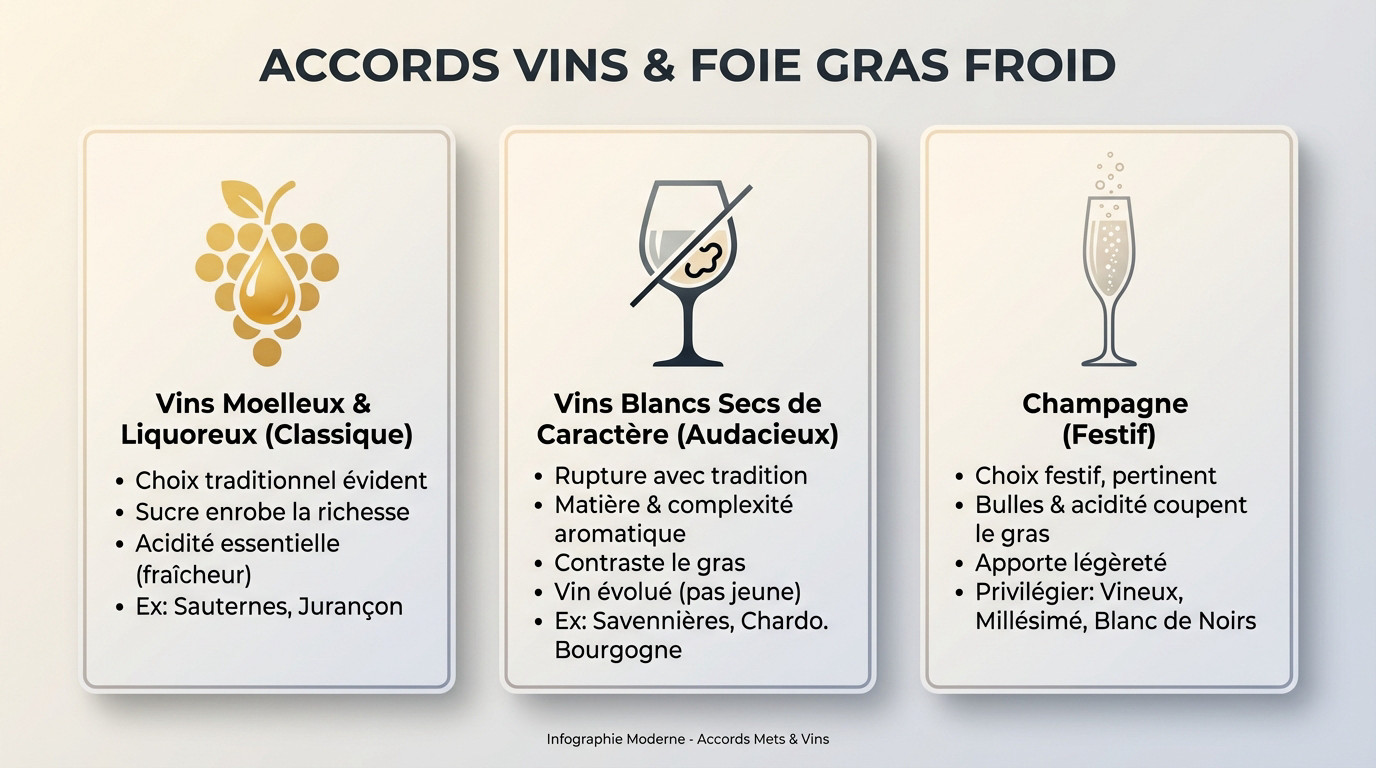
Unmissable duo: sweet and dessert white wines
For majority, this alliance is obvious. Wine's residual sugar envelops foie gras richness, creating velvety texture. It's comfort pairing par excellence, ideal to tame duck power.
However, beware of heaviness. Great dessert wine must possess cutting freshness to cleanse palate. Without this backbone acidity, pairing quickly becomes cloying.
Bet on safe values: Sauternes, Barsac, or Monbazillac. Coteaux du Layon or Jurançon remain brilliant alternatives thanks to their sugar/acidity balance.
Bold alternative: character dry white wines
To break with tradition, dry white wines work wonderfully, provided having substance. Idea is to contrast, not accompany fat.
Orient yourself toward character wines. Savennières for its mineral tension, aged Alsatian Pinot Gris, or great Burgundy Chardonnay will do. Wine must have body.
Golden rule: wine must be evolved. Young and lively white would be too aggressive for foie texture.
And champagne in all this?
Champagne is relevant technical choice. Its bubbles and acidity offer invigorating contrast cutting sharply through fat, bringing welcome lightness to tasting.
Favor vinous, vintage Champagne or Blanc de Noirs. Avoid too simple bruts lacking complexity facing dish richness.
When foie gras goes to pan: rule change
Why seared foie gras requires different wine
Forget mi-cuit sweetness. Here, heat attacks matter, causes Maillard reaction, and releases intense grilled aromas. Fat melts, caramelizes, and develops hazelnut notes demanding response in glass.
Your wine must display solid structure not to collapse. While acidity remains vital to cut through fat, we now seek aromatic complexity capable of supporting this pairing with seared foie gras.
Dry whites holding distance
Bet on dry white wines with oily texture. Alsatian Gewurztraminer, exuberant with its lychee touches, works wonders, especially if your plate includes some seared fruits.
Also think of great barrel-aged Chardonnays, Meursault type. Their buttery and toasted notes embrace cooking. Otherwise, Condrieu or white Saint-Joseph will bring welcome amplitude.
For seared foie gras, wine must not only refresh, it must dialogue with dish richness, creating bridge between fat and grilled.
Red option: risky but rewarding bet
Serving red here isn't heresy, it's calculated boldness. But beware, trap is deadly: tannins.
Fat and astringency cordially hate each other. Too young or rough red will cause disastrous metallic sensation drying palate. You must imperatively track patinated structures, with melted and silky tannins.
Aim for old Pomerol or evolved Saint-Émilion. Aged Burgundy Pinot Noir also works, like light red wine from Beaujolais, Morgon type, served slightly cool.
Successful pairings dashboard
To see more clearly and have practical guide at hand, here's best options summary according to each situation.
Best wine and foie gras pairings synthesis
Here's simple tool to never make mistake again when choosing your bottle. These tracks are serious, but don't see them as rules set in stone. Personal experimentation remains best compass.
| Foie Gras Type | Classic Pairing | Trendy Alternative | Why in Brief |
|---|---|---|---|
| Goose mi-cuit foie gras | Sweet Jurançon | Ripe Alsatian Pinot Gris | Wine sweetness respects goose finesse without crushing it. |
| Duck mi-cuit foie gras | Sauternes | Vintage Champagne | Power against power; bubbles bring welcome freshness. |
| Seared foie gras | Gewurztraminer | Old Pomerol | Spicy aromas respond to grilled, or melted tannins accompany it. |
| Foie mousse | Crémant de Loire | Dry and fruity white wine | Bubbles' lightness ideally contrasts with airy texture. |
Beyond classic: particular situations and practical advice
Basic pairings are mastered, but complex meals sow doubt. Let's tackle these often neglected particular cases.
Thorny case of multiple starters: foie gras and smoked salmon
Ignoring this taste conflict risks ruining. Foie gras requires fat and sugar, salmon demands liveliness and iodine. Dessert wine on fish is disaster, like too incisive white on foie.
Solution? Versatility. Opt for Blanc de Blancs Champagne or low-dosage Crémant. Their acidity and bubbles manage fat without crushing salinity. It's Swiss Army knife of festive meal wines.
Serving temperature: detail changing everything
Wine served at wrong temperature is wasted. It's unforgivable mistake with foie gras.
Serving dessert wine too cold anesthetizes its aromas and hardens sugar, while too warm red wine will see its alcohol dominate and its tannins assault palate.
- Dessert wines (Sauternes, Jurançon): 10-12°C. Never frozen, take out 20 minutes before.
- Dry white wines and Champagne: 8-10°C. To preserve tension and freshness.
- Evolved red wines: 16-17°C. Definitely not at room temperature.
Goose or duck foie gras: real difference for wine?
Goose foie gras, of extreme finesse, possesses subtle flavor. It requires elegant wines not crushing it, like old Riesling or delicate Champagne.
Duck foie gras, more rustic and powerful, requires character. It fully flourishes with rich dessert wine or opulent white.
Perfect pairing between wine and foie gras ultimately depends on your personal preferences and chosen preparation type. While dessert wine remains safe value, we observe that dry white or evolved red boldness also elevates this exceptional dish. Now it's up to you to experiment to find your ideal harmony.FAQ
What wine to choose to accompany foie gras?
For successful pairing, we primarily seek balance between dish richness and wine structure. Traditionally, sweet or dessert white wine, like Sauternes or Monbazillac, constitutes safe value because residual sugar envelops foie gras smoothness while bringing aromatic complexity.
However, we observe growing trend toward more modern pairings. Dry white wine with body and beautiful acidity, or even vinous Champagne, allows cutting through fat and refreshing palate, thus avoiding heaviness sometimes felt with too sweet wines.
What Alsatian white wine to favor with foie gras?
Alsace offers remarkable options to elevate this dish. Pinot Gris, especially if it's Late Harvest, is often our first choice for its roundness and smoky notes responding to foie gras power.
Gewurztraminer is also serious candidate, particularly if foie gras is enhanced with spices or served with exotic fruits. Its lychee and rose aromas create interesting aromatic echo, provided choosing bottle with good freshness not to saturate taste buds.
What best accompanies foie gras for perfect pairing?
Beyond toasted bread, it's wine playing principal partner role. What best accompanies foie gras is nectar capable of dialoguing with its melting texture. Dessert white wines from Southwest or Loire remain undethroned historical companions.
If we seek to go off beaten path, dry and mineral white wine, or vintage Champagne, brings welcome liveliness. Essential is avoiding too tannic red wines, because tannins' astringency clashes with fat and creates unpleasant metallic sensation.
What wine to serve if offering both foie gras and smoked salmon?
It's complex situation, because foie gras requires sweetness or fat, while smoked salmon demands liveliness and acidity. Serving dessert wine on salmon would be major taste mistake.
Ideal solution lies in choosing versatile wine: Blanc de Blancs Champagne or great low-dosage Crémant. Their fine bubbles and cutting acidity cleanse palate of foie fat while matching fish salinity, acting as true link between both starters.
What wine to pair with apple-seared foie gras?
Seared cooking caramelizes foie and gives it grilled and melting notes calling for wine with more response. We advise here opulent and aromatic white wines, like Gewurztraminer or barrel-aged Chardonnay, whose buttery notes recall cooking.
If apples accompany dish, wine's fruity side must be present. Semi-dry white wine or even ice cider can create magnificent resonance pairing with cooked fruit's acidity and sugar.
What wine ideally accompanies foie gras mousse?
Foie gras mousse possessing airier and less dense texture than whole foie gras, it requires wine not crushing it by its power. We favor here lightness and freshness.
Crémant de Loire or dry and fruity white wine works wonderfully. Wine's effervescence or liveliness comes underlining mousse's delicacy without dominating its subtle flavors.
Is Pinot Gris good choice with foie gras?
Absolutely, Pinot Gris is one of most seductive alternatives to classic dessert wines. This grape variety naturally possesses rich texture and opulence allowing it to stand up to foie fat, without falling into sugar excess.
We recommend choosing Pinot Gris with few bottle years. With age, it develops undergrowth and candied fruit notes that perfectly harmonize with foie gras earthy character.
How to accompany foie gras slice served as starter?
For starter, it's crucial not to saturate palate from meal beginning. If serving cold foie gras slice, orient yourself toward white wine possessing beautiful acidity to "rinse" mouth, like Jurançon or Loire Chenin.
Accompaniment also passes through serving temperature. Ensure wine is cool but not frozen, to preserve its aromas and not harden foie gras texture in mouth.
What does 20-minute rule for wine service consist of?
This simple empirical rule helps us serve wine at ideal temperature. It stipulates white or dessert wine must be taken out of refrigerator 20 minutes before serving, so it's not too cold and releases its aromas.
Conversely, for light red wine accompanying foie gras, it should be placed in refrigerator 20 minutes before service. This allows slightly cooling it and attenuating alcohol perception, making pairing more harmonious.