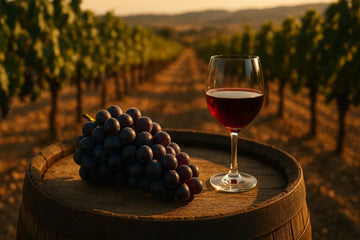
Key takeaways: Grenache, originating from Aragon, embodies the sun grape par excellence. Thriving in warm terroirs, it produces powerful red wines, aromatic rosés, and complex rancio VDNs. Its versatility and resistance to arid soils make it a pillar of Mediterranean regions. Discover Casa Rojo Enemigo Mío, symbol of its generosity.
The Grenache grape variety challenges wine enthusiasts: how can a single grape variety produce both powerful wines, silky rosés, and natural sweet wines? Discover the history of this Mediterranean grape variety born in Aragon, which has become essential from southern France to Spanish Priorat. Behind its vigor and thick berries, it reveals precise requirements: poor soils and mastery of its weaknesses. This king of the sun expresses, through terroirs and blends, aromas of black fruits, garrigue, or cocoa, creating emblematic wines like Châteauneuf-du-Pape or Natural Sweet Wines from Roussillon.
- The Grenache grape variety: portrait of a sun king
- At the origins of Grenache, a Mediterranean epic
- In the vineyard: a robust but demanding grape variety
- World tour of Grenache terroirs
- The multiple faces of Grenache wines
- Grenache treasures: VDN and other variants
- Tasting and appreciating Grenache
- The Grenache grape variety in brief
The Grenache grape variety: portrait of a sun king
Behind its thick skin and legendary vigor lies a grape variety born in the arid lands of Aragon, Spain. Grenache, or Garnacha, embodies the soul of Mediterranean regions. Resistant to drought, it transforms heat into fruity, powerful, and fleshy wines.
Grenache is the sun grape par excellence. It transforms heat and drought into generous, fruity, and powerful wines, true reflections of Mediterranean terroirs.
Used alone or in blend, it produces rich red wines, silky rosés, and concentrated natural sweet wines. Its vines, adapted to lean soils, thrive without excessive irrigation. To balance its lack of acidity, it allies with Syrah or Carignan, reinforcing structure and complexity.
Red wines reveal aromas of black cherry, blackberry, and pepper, evolving toward cocoa or candied fruit notes. Its rosés, like those from Tavel, offer freshness and lightness. In Natural Sweet Wines (Banyuls, Maury), it reveals concentration and exceptional aging potential. A grape variety where heat transforms into generosity.
At the origins of Grenache, a Mediterranean epic
From Aragon to world conquest
Grenache traces its origin to Aragon vineyards, in northeastern Spain. It's there that this grape variety, called Garnacha, was born, probably in the Middle Ages. The power of the Kingdom of Aragon, master of Mediterranean routes, allowed it to flourish well beyond the Pyrenees.
Subsequently, its diffusion accelerates. In the 15th century, it settled in Catalonia, then crossed the Pyrenees thanks to commercial and cultural exchanges. The grape variety gained Roussillon, Provence, Corsica, and Sardinia. This early expansion explains its current dominance in hot and dry regions, where its drought resistance makes it a valuable ally.
Garnacha, Cannonau: a history of names
In its Spanish cradle, Grenache bears the name Garnacha, a term still used in Rioja or Priorat appellations. In Sardinia, it becomes Cannonau, a synonym testifying to its local anchoring. In France, a forgotten designation, Alicante, recalls its passage through Languedoc vineyards.
In French, the word "grenache" has long sparked debates about its gender. However, usage has established itself: one says "le grenache," a masculine noun, consistent with other grape varieties like "le merlot" or "le chardonnay." This linguistic clarification enlightens wine enthusiasts on how to refer to it correctly, without ambiguity.
In the vineyard: a robust but demanding grape variety
Grenache, originating from Aragon in Spain where it's also called Garnacha, is distinguished by exceptional vigor. It's a productive grape variety, but this abundance requires rigorous control to guarantee grape quality. This is where human intervention becomes necessary.
Adapted to dry climates, it resists drought and strong winds, making it ideal for Mediterranean terroirs. It thrives on lean, stony, or schistous soils, where other grape varieties struggle to express themselves. This penchant for austerity explains its dominance in regions like Languedoc or Roussillon, where draining soils force roots to seek water deep down.
Yet, this robust grape variety hides fragilities. It's sensitive to downy mildew, excoriosis, gray rot, and coulure, this phenomenon reducing yields in humid summers. Its thick bark doesn't protect it from premature oxidation either, requiring careful attention in case of excessive humidity.
To tame this vigor, winemakers often opt for short pruning in goblet or cordon. This practice limits yields and concentrates aromas in berries. Without this control, wines risk lacking structure and complexity, despite their natural power.
By combining its resistance to extreme conditions with its ability to adapt to difficult terroirs, Grenache embodies a fragile balance between rusticity and viticultural requirement. This paradox makes it an essential but demanding grape variety in many warm regions worldwide.
World tour of Grenache terroirs
Grenache, black grape variety originating from Spain, establishes itself in hot and dry regions thanks to its exceptional drought resistance. Adapted to lean and stony soils, it excels in blend with Syrah and Carignan. Cultivated on approximately 200,000 hectares, this grape variety produces fruity, powerful, and fleshy wines, but also natural sweet wines like Banyuls or Maury. Discover its expressions around the world.
- France: Rhône Valley (Châteauneuf-du-Pape, Gigondas), Languedoc-Roussillon (Maury), Provence (Tavel rosés).
- Spain: Priorat (black and white Garnacha), Rioja (blend with Tempranillo).
- Italy: Sardinia (Cannonau di Sardegna DOC, linked to inhabitants' longevity).
- New World: Australia (Barossa Valley, McLaren Vale), United States (California, Paso Robles).
Spain, its cradle
In Spain, Grenache, named Garnacha, reaches its peak in Priorat. Its century-old vines, planted on schistous soils (licorella), produce mineral, concentrated wines with fine tannins. In the 1980s, pioneers like René Barbier revived this grape variety by valorizing ungrafted old vines. The Acústic Celler Rouge 2020 cuvée embodies this heritage. In Rioja, it allies with Tempranillo to bring structure and roundness, while in Aragon, "sangre de Aragón" establishes itself in full-bodied blends.
France, its chosen land
With 90,000 hectares, France is its leading producer. At Châteauneuf-du-Pape, Grenache ripens on soils of rolled pebbles and safres, offering wines rich in black fruits, cooked plum, and spices. In Languedoc-Roussillon, it expresses unexpected freshness on schists and clays, particularly in IGP Côtes Catalanes. In Provence, it gives body and balance to emblematic Tavel rosés. Its low acidity and high alcohol content (up to 15°) make it a demanding but essential grape variety.
Beyond Europe
In Sardinia, Cannonau produces full-bodied wines, rich in polyphenols, associated with inhabitants' longevity. In Australia, Barossa Valley and McLaren Vale explore its old vines (sometimes planted in 1848) for aging wines, like Charles Melton's "Nine Popes." In California, regions like Paso Robles rediscover its old vines for bold blends. This traveling grape variety, linked to Mediterranean climates, maintains its fruity and gourmand signature, crossing continents without losing its soul.
The multiple faces of Grenache wines
Red wines: a powerful and fruity character
Black Grenache embodies the generosity of Mediterranean terroirs. In warm regions like Roussillon or Rhône Valley, it produces wines rich in alcohol (up to 15°) and aromas, thanks to its thick berries that concentrate sugar and flavors. This grape variety originating from Aragon prefers lean and stony soils, reducing its yield to amplify its intensity. Its low acidity, sometimes a challenge in winemaking, is compensated by rigorous extraction management to avoid rough tannins. In Châteauneuf-du-Pape cuvées, it can age several decades, gaining complexity with underbrush or candied fruit notes.
In Spain, Grenache takes the name Garnacha and fully expresses itself in Priorat, on black schists. A particular variety, Hairy Grenache (Garnacha Peluda), develops more marked acidity, suited to balanced styles. Its versatility makes it essential, whether in single-varietal or blend.
The aromatic palette of red Grenache
- Youth aromas: black fruits (blackcurrant, blackberry), black cherry, cooked plum, with licorice or cocoa nuances
- Aromas with age: stewed or candied fruits, sweet spices, fig, leather, and smoky accents
Young Grenache wines reveal bursting fruitiness, often associated with spicy notes of cinnamon or white pepper. With age, aromas evolve toward leather, tobacco, or mushroom scents, recalling undergrowth. Natural sweet wines (VDN) like Banyuls or Maury exploit its sugar concentration, offering surprising freshness despite their power. These alcohol-fortified cuvées reveal dried fruit, roasted cocoa, and candied orange flavors, ideal with blue cheese or chocolate dessert.
The art of blending and rosés
Grenache dominates complex blends, notably in the emblematic GSM trio (Grenache, Syrah, Mourvèdre) from Côtes du Rhône. Its role is clear: bring roundness and ripe fruit aromas. Syrah, by adding color and peppery notes, balances its power. Mourvèdre, meanwhile, structures the whole with its firm tannins and freshness. In Languedoc-Roussillon, alliance with Carignan is frequent: its vivacity compensates Grenache's roundness, creating balanced and speckled wines.
In rosés, Grenache shines at Tavel, where it composes with Cinsault fleshy and aromatic wines. According to 2023 data, it represents 57% of black grape varieties used in the appellation. These rosés, vinified by bleeding, offer peach and redcurrant aromas, with unexpected minerality. To discover other successful alliances, explore blending grape varieties and their essential combinations.
Grenache treasures: VDN and other variants
Natural sweet wines (VDN), Roussillon's gold
Grenache, grape variety originating from Spain, reveals its full potential in Roussillon's natural sweet wines (VDN). Its richness in natural sugar makes it the ideal base for these unique wines. Two styles dominate: "Vintage" VDN..."Rancio" VDN.
Grenache's "rancio" profile is a true metamorphosis: fruit gives way to complex notes of dried fruits, cocoa, and spices, offering an unforgettable tasting experience.
AOP Banyuls, Maury, Rasteau, and Rivesaltes embody this diversity. At Banyuls, Grenache and Carignan blend offers candied blackberry and bitter chocolate aromas. Rivesaltes, with its white Grenache aged seven years, unveils blood orange and candied chestnut flavors. Maury, meanwhile, stands out for its spicy power and smoothness.
The family grows: white Grenache and gray Grenache
| Variant | Wine Profile | Main Aromas | Notable Regions | |
|---|---|---|---|---|
| Black Grenache | Red, Rosé, VDN | Powerful, fleshy, rich in alcohol | Black fruits, spices, garrigue | Rhône, Roussillon, Priorat |
| White Grenache | White | Ample, round, low acidity | White flowers, fennel, green citrus | Rhône, Roussillon, Spain |
| Gray Grenache | Rosé, White (often in blend) | Fine, mineral, delicate | Small red fruits, almond, anise notes | Roussillon, Provence |
Behind black Grenache hide two precious variants: white and gray. White Grenache, natural mutation of black, produces round wines with white flower and green citrus aromas. It enters blends or expresses itself alone, as in the emblematic example of Acústic Celler Blanc 2021. Gray Grenache, rarer, produces delicate wines with anise notes and mineral accents. It's often used in blend to bring finesse and complexity.
Tasting and appreciating Grenache
When to drink a Grenache wine?
Grenache, black grape variety originating from Spain, produces fruity, powerful, and fleshy wines. Resistant to drought and adapted to lean terroirs, it fully expresses itself in youth (2-5 years) for rosés or simple reds, revealing red fruit, blackberry, or cooked plum aromas. Cultivated in warm regions like Languedoc or Aragon, it captures terroir flavors while maintaining its structure.
Concentrated cuvées, from demanding terroirs like Châteauneuf-du-Pape or Priorat, age up to 30 years. Châteauneuf-du-Pape's stony soils, for example, bring minerality and complexity, ideal for progressive aging. Over time, these wines develop leather, spice, and truffle notes. One-hour decanting softens tannins and releases aromas. Served between 13 and 16°C, Grenache preserves its freshness and balance, especially fruity cuvées.
Best food and wine pairings
- Red wines: Grilled meats (herbed lamb, beef in sauce), Mediterranean dishes (daube, carbonnades), roasted duck breast. Blended with Syrah and Carignan, it supports intense flavors, like wild boar stew.
- Natural Sweet Wines (VDN): Pan-seared foie gras with fresh figs, blue cheeses (Roquefort), or dark chocolate desserts and walnut tart. Maury and Rivesaltes, with their oxidative aging, offer dried fruit, cocoa, or coffee nuances, ideal for candied apricot pastries.
Grenache also pairs with sweet-savory dishes (tagine with dried apricots) or strong cheeses, revealing cocoa notes. A light rosé is enjoyed as aperitif with chorizo and manzanilla tapas, while oxidized VDNs accompany candied fruit pastries, for a gourmet meal ending.
The Grenache grape variety in brief
Originating from Aragon in Spain, Grenache, also named Garnacha, establishes itself as a grape variety resistant to drought and lean soils. Its sugar-rich grapes produce powerful, fleshy wines with black fruit aromas. Frequently associated with Syrah and Carignan, it brings roundness and complexity to blends, notably in Rhône Valley wines. Renowned for natural sweet wines (Banyuls, Maury), it reveals exceptional aromatic potential through oxidative aging. To explore its generosity, Casa Rojo Enemigo Mío perfectly embodies its balance between power and freshness.
Grenache, originating from Spain (Garnacha), is the emblematic sun grape variety. Resistant to drought, it produces fruity and spicy red wines, shines in blend (GSM), and elevates VDNs. To discover its generosity, taste Casa Rojo Enemigo Mío 2022.